
Aether The Fifth Element – an ancient understanding for modern healing.
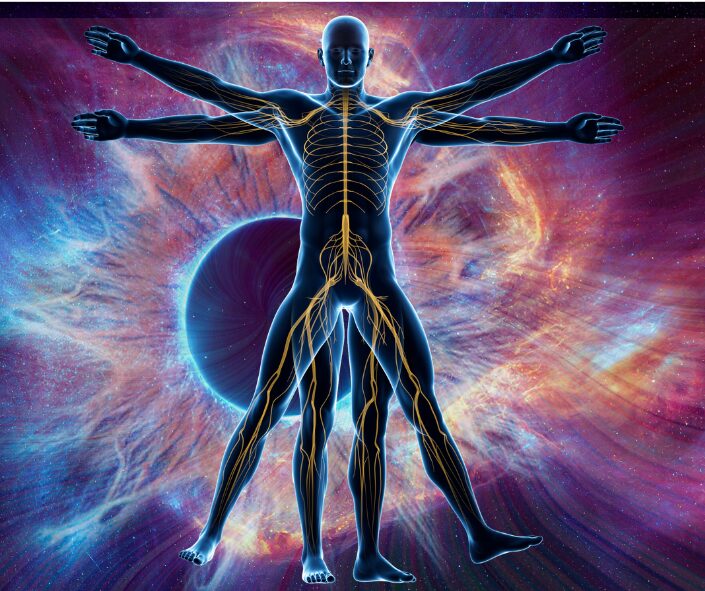 One of the biggest challenges for people to get their heads around remote healing is how can these connections between healer/healing device and the person being healed exist?
The modern physics principles of quantum entanglement go some way to clarify for some people. However, most of us are used to actions at a distance resulting from connections you can see and touch. Examples being a wire connecting the power station and your light bulb or the detectable electrical pulses connecting your phone to the nearest cell tower.
You don’t have to go too far back in history to find our own ancestors with an understanding that would easily embrace the principles of remote vibrational healing because they had an understanding of something commonly called Aether. Maybe, like an old sixties pop song, it is time for a comeback!
The History of Aether- the fifth element.
For most of human history, the universe was not seen as empty space punctuated by matter, but as a living continuum structured by fundamental forces and substances. Among these, Aether—the fifth element—stood apart. It was not merely another component like earth, water, air, or fire; it was the underlying essence that bound them together.
Today, although dismissed by mainstream science in its original form, some argue that aether has not disappeared at all. Instead, it may have been renamed—reinterpreted as dark energy, quantum fields, or zero-point energy. Whether metaphor or misunderstood reality, the idea of a fifth element continues to bridge ancient philosophy and modern speculation.
The Classical Elements and Their Hidden Unity
Ancient systems across Greece, India, and beyond described reality through four primary elements:
- Earth — solidity, structure, and stability
- Water — fluidity, emotion, and adaptability
- Air — intellect, movement, and communication
- Fire — transformation, energy, and will
These elements were not just physical substances but principles of experience and existence. Yet, even in early teachings, there was recognition that something deeper was required—something that connected and animated them.
This was Aether.
Rather than existing alongside the four elements, aether was often described as the field in which they arise, the invisible fabric that gives coherence to all forms. It was not just a fifth component—it was the context of existence itself.
Aristotle’s Aether: The Substance of the Heavens
In Western philosophy, aether was formalized by Aristotle, who argued that the heavens must be made of a fundamentally different substance than the Earth.
Unlike the four elements, which were subject to change and decay, aether was:
- Eternal and unchanging
- Perfect and incorruptible
- Moving in circular, harmonious motion
It filled the cosmos beyond the Moon and formed the stars and planets. In this view, aether was not mystical but logical—a necessary explanation for the apparent perfection of the celestial realm.
This idea endured for centuries, shaping how reality itself was understood.
Quintessence: The Spiritual Dimension of Aether
As philosophical traditions evolved, especially during the medieval period, aether took on a more spiritual and symbolic role.
Known as quintessence, it became:
- The purest essence underlying all matter
- A bridge between the physical and the divine
- A unifying force connecting body, mind, and spirit
In alchemical traditions, quintessence was not just theoretical—it was something to be refined, extracted, or realized, representing ultimate balance and harmony.
From this perspective, the four elements described the manifest world, while aether represented the unmanifest source—the subtle field from which all form emerges.
The Scientific Reinvention of Aether
With the rise of modern science, aether was not abandoned but redefined.
By the 18th and 19th centuries, scientists faced a critical question: how does light travel through empty space? Waves required a medium, and so a new concept emerged—the luminiferous aether.
This scientific aether was described as:
- Invisible and all-pervading
- Extremely light yet rigid enough to carry light waves
- Present even in a vacuum
It became a foundational assumption in physics, supporting theories of electromagnetism and optics. For a time, aether was not philosophy—it was cutting-edge science.
Collapse and Reinvention
The turning point came in 1887 with the Michelson–Morley experiment, which failed to detect any evidence of Earth moving through an aether medium. This result destabilized the theory, but it was Einstein’s 1905 theory of relativity that ultimately rendered aether unnecessary.
Light no longer needed a medium. Space itself became dynamic.
By the early 20th century, aether had been removed from scientific models—not because it was disproven in a direct sense, but because it was no longer required.
Aether in Modern Language: A Disguised Return?
Here is where the story becomes more speculative—and more intriguing.
Modern physics does not describe space as truly empty. Instead, it is filled with:
- Quantum fields, underlying all particles
- Zero-point energy, the lowest energy state of a system
- Dark energy, driving the expansion of the universe
These concepts suggest that what we call “vacuum” is actually a sea of potential and activity.
Some interpretations—particularly outside mainstream physics—draw parallels between these ideas and ancient descriptions of aether:
- Like aether, quantum fields are everywhere
- Like quintessence, zero-point energy represents a baseline of existence
- Like the fifth element, dark energy shapes the structure of the cosmos itself
However, it is important to be precise: modern physics does not equate these directly with aether. The similarities are conceptual, not historically continuous. Still, the resonance is difficult to ignore.
The Fifth Element as a Conceptual Bridge
Whether taken literally or metaphorically, aether serves as a powerful idea—a way of thinking about unity beneath diversity.
The four classical elements describe how the world appears: solid, fluid, dynamic, and transformative.
Aether describes what allows those qualities to exist at all.
In this sense, the fifth element is less about a missing substance and more about a missing perspective. It invites us to consider that reality may not be built from isolated parts, but from interconnected layers of structure and meaning.
Conclusion: Lost, Rejected, or Transformed?
Aether was never part of the modern periodic table, nor does it exist as a measurable element in contemporary science. And yet, its legacy persists.
From Aristotle’s perfect heavens to medieval quintessence, from Victorian physics to modern quantum theory, the idea of a pervasive, unifying medium continues to reappear—renamed, reframed, and reinterpreted.
Perhaps aether was not so much wrong as premature—an intuitive grasp of something that science would later approach from a different angle.
Or perhaps it remains what it has always been: a symbol of humanity’s attempt to understand the invisible foundation of reality.
Either way, the fifth element has never truly vanished. It has simply changed its language.
If you would like to explore the possibilities of remote healing with or Quantum Scalar Box, hit the product link below.
-

QSB Wave
Price range: $699.99 through $1,999.98 Select options This product has multiple variants. The options may be chosen on the product page