
Parasites and EMF. IS EMF opening the door to infestation?
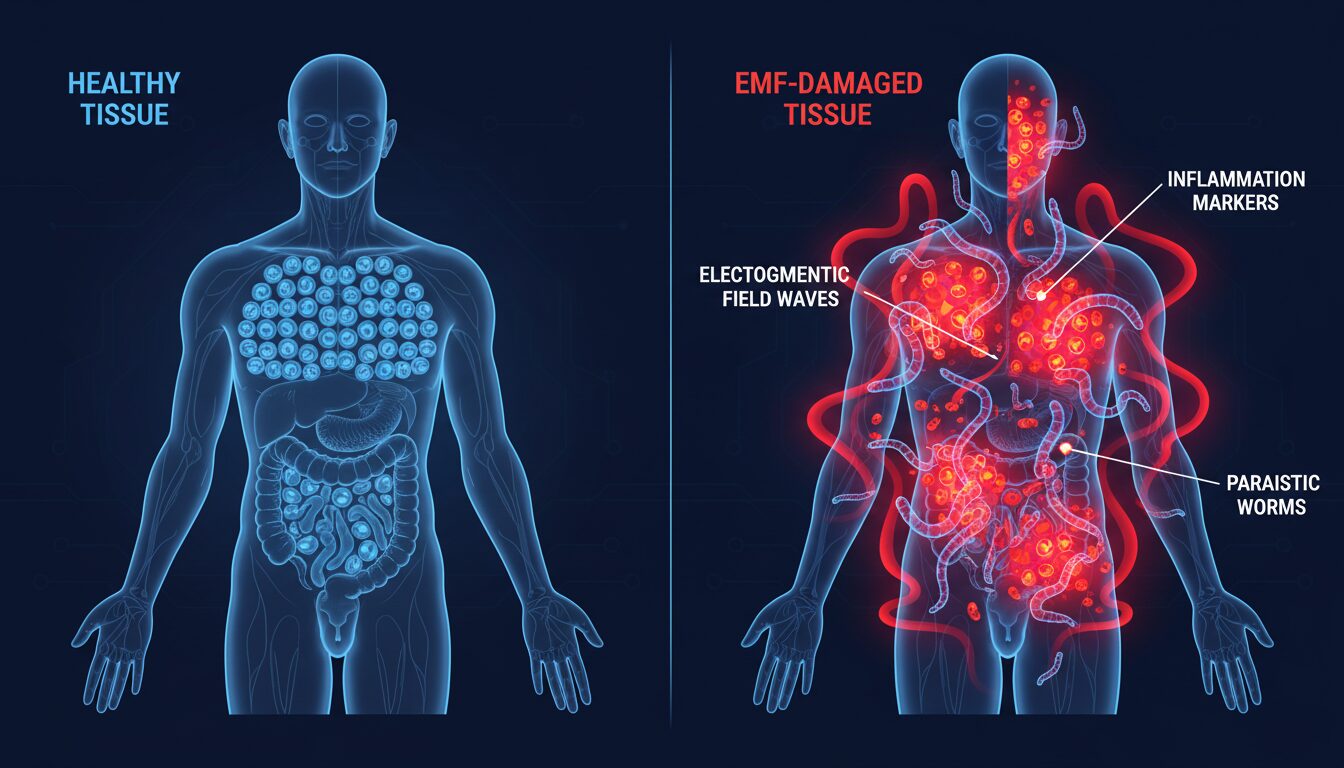
Reworked from Norman James’s original article The Beacon and the Bus: How EMF Exposure May Attract Parasites to Damaged Tissue
Parasites and EMF
For years, electromagnetic field (EMF) researcher Norman James has documented the biological effects of wireless radiation. Recently, he’s uncovered a disturbing connection: parasites may be drawn to EMF-damaged tissue like moths to a flame. His hypothesis suggests that our wireless world isn’t just making us sick—it’s painting targets on our bodies for opportunistic invaders.
The Convergence of Two Health Crises
James describes experiencing what he calls “the perfect storm of modern health disasters.” As he writes, “I’ve spent years documenting electromagnetic field exposure and its biological effects. I’ve spent the last months dealing with a parasitic infection that conventional medicine struggles to acknowledge, let alone treat.” This personal battle led him to a startling realization about how these two seemingly unrelated health threats might be intimately connected.
The hypothesis is both elegant and alarming: electromagnetic fields damage tissue at the cellular level, and parasites—particularly migrating larvae—are evolutionarily programmed to seek out exactly this type of compromised tissue as ideal real estate for their development.
How EMF Creates Cellular Damage
The mechanism begins with oxidative stress. As James explains, “When your cells are exposed to EMF, they experience oxidative stress—an imbalance between free radicals and antioxidants.” This isn’t speculative; it’s documented in thousands of peer-reviewed studies showing that radiofrequency radiation generates reactive oxygen species (ROS) that damage cellular structures.
This damage manifests in several ways: disrupted calcium channels, compromised cell membranes, mitochondrial dysfunction, and chronic inflammation. The result is tissue that’s metabolically stressed and sending out distress signals—signals that parasites may have evolved to detect.
The Parasite’s Perspective
Parasitic worms, particularly in their larval stages, face a critical challenge: finding suitable tissue for development. James notes that “parasites aren’t random wanderers—they’re sophisticated biological machines with millions of years of evolutionary programming.” They’ve developed exquisite sensitivity to chemical gradients, temperature variations, and inflammatory markers.
Damaged tissue offers parasites several advantages: weakened immune responses, altered pH levels, increased vascular permeability for nutrient access, and reduced cellular defenses. As James puts it, “EMF-damaged tissue might be broadcasting ‘vacancy’ signs that parasites can detect and follow.”
The Inflammatory Beacon
The connection becomes clearer when examining inflammation. EMF exposure triggers inflammatory cascades, releasing cytokines and chemokines—the same chemical signals that parasites use to navigate host tissue. James observes, “Your EMF-damaged tissue is literally lighting up the neighborhood for any passing parasite larvae.”
This creates a vicious cycle: EMF causes inflammation, inflammation attracts parasites, parasites cause more inflammation, and the compromised tissue becomes even more vulnerable to EMF damage. It’s a downward spiral that conventional medicine, treating each issue in isolation, fails to address.
Real-World Implications
The practical implications are sobering. James points to modern sleeping arrangements as a prime example: “You sleep with your phone on the nightstand. Maybe you have a smart meter on the bedroom wall. Your WiFi router runs 24/7.” These constant exposures create zones of chronic tissue damage—and potential parasite attraction.
He describes his own experience: “The areas where I experienced the most intense parasitic activity correlated almost perfectly with my highest EMF exposure zones.” While anecdotal, this observation aligns with the theoretical framework and deserves serious investigation.
The Research Gap
Despite the biological plausibility, James acknowledges this remains largely unexplored territory. “I can’t point you to a peer-reviewed study titled ‘Parasites Prefer EMF-Damaged Tissue’ because it doesn’t exist yet,” he admits. The research community has studied EMF effects and parasite behavior separately, but rarely considered their interaction.
This gap isn’t surprising. Modern medicine’s reductionist approach struggles with multifactorial problems. As James notes, “We’ve created an environment so foreign to our evolutionary history that we’re seeing novel disease patterns that don’t fit into traditional diagnostic boxes.”
A Call for Investigation into Parasites and EMF
James isn’t claiming definitive proof, but rather presenting a hypothesis that demands investigation. The convergence of EMF proliferation and rising rates of mysterious chronic illnesses—many with parasitic components—suggests we’re missing something important.
His conclusion is measured but urgent: “Whether this hypothesis proves correct or not, we need to start thinking about environmental health factors as interconnected systems rather than isolated variables.” The beacon and the bus metaphor captures this perfectly—EMF damage may be the beacon, and parasites the bus that arrives to exploit the opportunity.
For those dealing with chronic health issues, particularly unexplained inflammation or suspected parasitic infections, James’s work suggests examining EMF exposure as a potential contributing factor. While more research is needed, the biological mechanisms are plausible enough to warrant both scientific investigation and personal precaution.